
Introduction
Expecting parents love little clues about their baby, from cravings to fetal movements. One widely discussed hint is the placenta’s location. Some claim that having an anterior placenta—where the placenta attaches to the front wall of the uterus—means you’re carrying a girl. It’s an appealing story, easy to share in online forums and social media.
However, science rarely confirms such simple predictions. In reality, the placenta’s position is mostly determined by implantation dynamics and maternal anatomy, not by the baby’s sex.
This article explores what an anterior placenta is, the origins of the “girl theory,” what research and medical experts actually say, and the safest ways to learn your baby’s sex. We’ll also cover practical considerations for pregnancies with an anterior placenta. By the end, you’ll know the difference between folklore and fact—and how to enjoy the guessing game safely.
What is an Anterior Placenta?
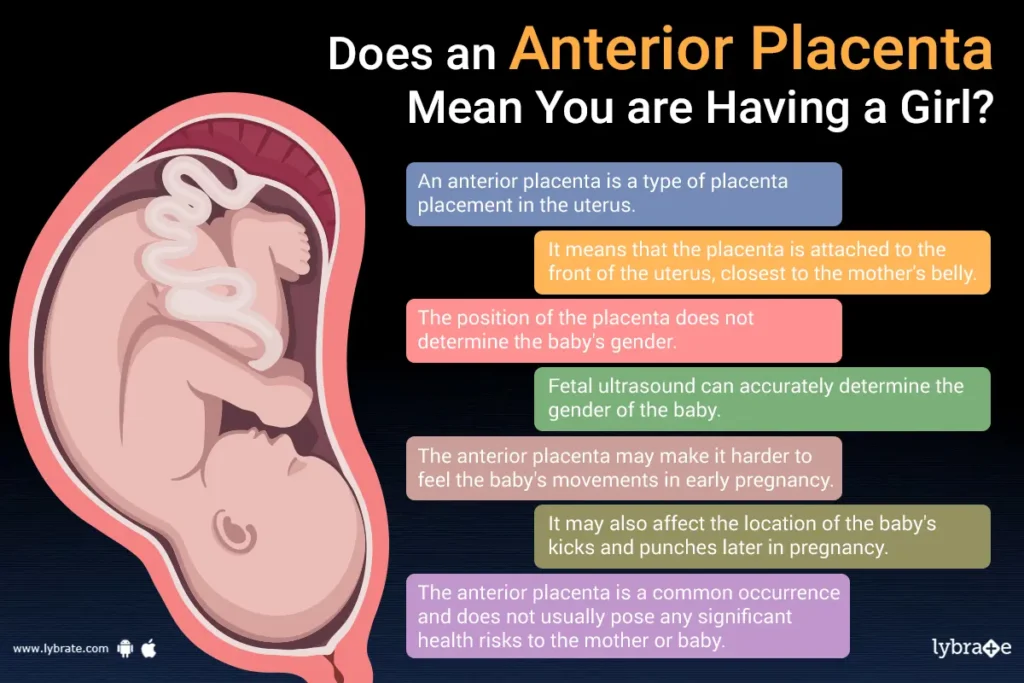
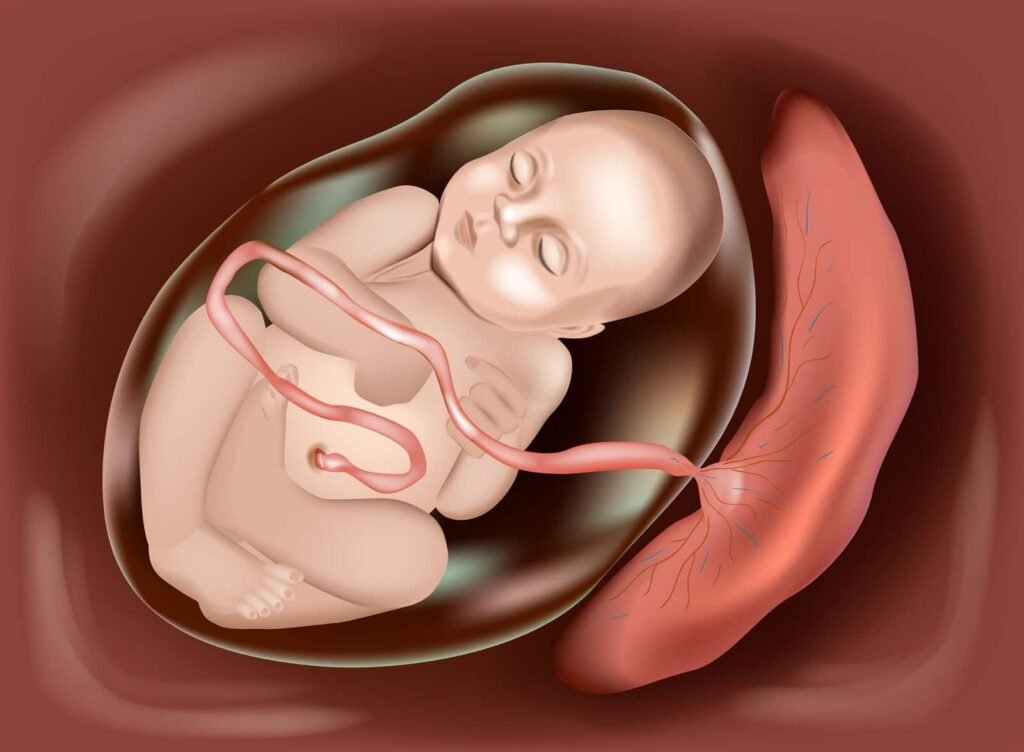
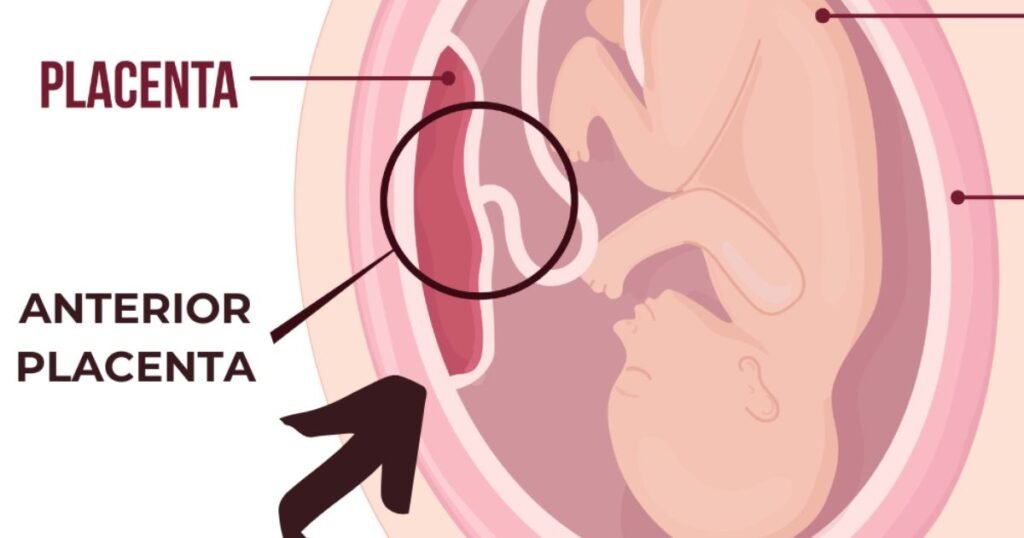
The placenta is the organ connecting the baby to the mother’s uterus, supplying nutrients and oxygen. When it attaches to the front wall of the uterus, it’s called an anterior placenta. If it attaches to the back, it’s posterior. Anterior placentas are common and generally harmless.
Some practical effects of an anterior placenta include:
- Delayed perception of fetal movements: Kicks may feel weaker or later because the placenta cushions movements.
- Heartbeat detection differences: Using a Doppler at home or in early pregnancy may be slightly more challenging.
Other than these minor differences, anterior placentas do not affect pregnancy outcomes for most healthy pregnancies.
Read More: Does an Anterior Placenta Mean You’re Having a Girl?
Where Did the “Anterior = Girl” Idea Come From?
The claim that anterior placentas predict female babies has multiple origins:
- Ramzi’s Theory: A controversial theory suggested early placental development on the left side of the uterus predicts a girl, while the right side predicts a boy. While often associated with placenta location, Ramzi’s theory refers specifically to left/right placement, not front/back (anterior/posterior). Large-scale studies have not confirmed it.
- Small Observational Studies: Some small research papers noted trends suggesting girls might more often have anterior placentas. However, these studies were limited in size and methodology, making conclusions unreliable.
- Social Media & Anecdotes: Personal stories in forums and social media amplify patterns. People remember when a prediction “worked” and forget when it didn’t, creating confirmation bias. This anecdotal spread fuels the myth.

What Medical Experts Say
Major health organizations emphasize that placenta location cannot reliably predict baby’s sex. Evidence-based recommendations include:
- Cleveland Clinic and similar hospitals: There is no scientific proof that an anterior placenta predicts a girl. Gender predictions should rely on validated medical tests.
- Reviews of Ramzi’s Method: Experts consider such methods unproven, with accuracy rates near chance (around 50%).
The consensus: fun for curiosity, but not a method for planning or expectation management.
Evidence from Studies
Looking at research on the topic:
- Mixed Results: Some small studies noted associations between anterior placentas and female babies, while others found no statistically significant correlation.
- Study Limitations: Many studies had small sample sizes, were single-center, or lacked rigorous controls, leading to potential false positives.
- Unproven Predictive Power: Larger validation studies are missing. When tested rigorously, claims about placenta-based gender predictions are essentially as accurate as flipping a coin.
In short, science does not support using placenta location as a reliable predictor of fetal sex.
Why Placenta Location Can’t Predict Sex
- Genetics Drive Sex: A baby’s sex is determined by chromosomes at conception. Placenta attachment occurs later and is influenced by implantation location and uterine shape, not genetics.
- Placenta Shifts Over Time: Placenta position can appear to change as the uterus grows, and early ultrasounds can be misread.
- Left/Right vs Front/Back Confusion: Some myths confuse lateral placement with anterior/posterior placement, complicating the idea of prediction.
- Small Sample and Anecdotal Bias: Observational anecdotes are prone to selection bias—people report hits, ignore misses.
How to Know Your Baby’s Sex Reliably
For accurate gender prediction, the following methods are evidence-based:
- Noninvasive Prenatal Testing (NIPT): A maternal blood test available around 9–10 weeks detects fetal DNA, including sex chromosomes. Highly accurate.
- Mid-Pregnancy Anatomy Scan (Ultrasound): Usually performed between 18–22 weeks, this scan can reveal fetal sex. Accuracy depends on fetal position and technician skill.
- Genetic Testing (CVS or Amniocentesis): Definitive, invasive tests used mainly for medical reasons, including chromosomal analysis.
These methods are scientifically validated, unlike predictions based on placenta location.
Practical Tips for Pregnancies with an Anterior Placenta
- Feeling Kicks Later: Movements may be delayed due to cushioning, but this is normal.
- Heartbeat Detection: Sometimes requires more patience or different positions during Doppler checks.
- Placenta Location Rarely Affects Delivery: Only if the placenta is over the cervix (placenta previa) does it influence birth planning.
Most pregnancies with anterior placentas progress normally.
Talking About Placenta-Gender Predictions
It’s fine to enjoy folklore or share guesses online, but clarify that predictions are unscientific. Encourage friends and family to treat it as a fun anecdote, not medical advice.
Quick Myth-Buster
- An anterior placenta does not reliably predict baby’s sex.
- Ramzi’s method and similar theories are unproven.
- Reliable methods for gender prediction include NIPT and mid-pregnancy ultrasound.
FAQs
1. Does an anterior placenta mean I’m having a girl?
No. Medical research shows no reliable correlation between anterior placenta and female babies.
2. Can placenta position predict sex early?
Methods like Ramzi’s theory (left = girl, right = boy) are unproven and not recommended.
3. How accurate is placenta-based gender prediction?
Accuracy is inconsistent and falls near chance levels (50%). It is not reliable.
4. When can placenta location be determined on ultrasound?
Placenta can be identified on routine ultrasounds by the mid-trimester (around 18–22 weeks), sometimes earlier on dating scans.
5. Should I tell friends that placenta predicted my baby’s sex?
It’s fine as a fun anecdote but clarify it’s folklore. Confirm with medical tests for certainty.
Read More: High-Protein Foods: A Smart Guide to Boosting Muscle, Health
Conclusion
In summary, an anterior placenta does not reliably indicate a girl. While small studies and social media stories may suggest patterns, scientific evidence does not support them. Placenta location is primarily influenced by implantation and uterine anatomy, and its main role is supporting fetal development, not revealing gender.
For a trustworthy answer, rely on validated methods such as NIPT, mid-pregnancy ultrasounds, or genetic testing if medically necessary. Folklore like “anterior placenta = girl” can be fun to discuss, but it should never replace evidence-based testing. Understanding the difference between myth and science helps expectant parents enjoy the journey without unnecessary stress or false expectations.